


Raising a Glass to Welsh Wine
Deliciously diverse and produced with passion, Welsh wine from boutique vineyards is gaining international respect for its quality and variety. Abigail Saltmarsh talks to Gwin Cymru members about the range and quality of the wines they have to offer.

With growing numbers of vineyards and increasing acclaim, the future for Welsh wine is looking robust and rosy. There are now more than 60 vineyards across Wales, ranging from those just starting out to others already scooping international accolades for their high-quality products.
Celebrated wine experts, including Oz Clarke, are full of praise for the confidence and character of Welsh wine. According to those in the industry, it is being noticed thanks to the hard work of the viticulturists, the suitability of the climate in Wales and the diversity of the country’s landscape.
Andy Mounsey is chair of Gwin Cymru, the Welsh regional association of WineGB. Former publishers, he and his wife Fiona launched Velfrey Vineyard in South Pembrokeshire in 2016 after being wowed by a bottle of Welsh wine from Jabajak Vineyard. They have now planted some 5,500 vines and have recently installed a winery.

“Wales is ideally suited to the production of clean, crisp, cool climate wines, but that covers quite a variety of different styles – and the really interesting thing about Wales is that the wine producers are very diverse in what they do,” he observes.
“A lot of English wine production is very much focused on the Champagne-style varieties of grape and method, which makes the typical English sparkling wine that people are very familiar with. There are some excellent examples of that here in Wales, but there’s also a great deal of diversity of other styles.
“There are white wines from classic grapes like Chardonnay, as well as from hybrids like Solaris and Siegerrebe. You’ve got pét nats, orange wines and biodynamic natural organic wines. There are red wines from different hybrid and classic grapes, and we have some excellent rosés as well.”
Tremendous diversity
Today, there are vineyards in South Wales with particular concentrations in Monmouthshire and the Vale of the Glamorgan. Also, Mid Wales, across North Wales, and in Pembrokeshire, Carmarthenshire and Ceredigion – almost everywhere other than the mountainous central sections of the country.
“Welsh wine has expanded so much recently because more people are tasting it and realising it really is of a very good quality. I think this gives others the confidence to give it a go, and then, invariably, the vineyards are small family enterprises, which means everybody brings their own philosophy to it,” he says.
“Deliciously diverse sums up the situation! We are producing lots of different styles of wine between us.”
Richard Morris started his operation at Ancre Hill Estates in Monmouthshire some 20 years ago. Today, the vineyard gains international acclaim for its biodynamic and organic wines.
“Our main reputation is around orange wine and pét nats – we were the first people in the UK to start making them in 2014 – they are now very trendy,” he explains. “We chose this particular spot near Monmouth because it was the right site.
“If you are planning a vineyard in this country, then you have to be site specific. You are looking for sheltered, frost-free spots with south-facing slopes. We are at the end of the Monnow Valley, which is perfect.”
Challenging the vines
Other major contributors to the multiplicity of Welsh wines are the diverse climates and soils. Across the country as a whole, climate change has had a major impact on the industry, making growing grapes a much less risky business. Fewer harsh frosts mean a lower chance of whole harvests being wiped out.
Velfrey grows its Pinot Noir, Seyval Blanc, Solaris and Rondo grapes in a sandy clay loam. This is also found in many leading wine-producing areas, including Saint-Emilion.
“The soil in Wales varies enormously. I think the common denominator really is that good wine comes from soils that challenge the vines. You want the grapes to survive and thrive, but you want them to be challenged by their conditions in one way or another.
“It’s also very much about the particular microclimate conditions of the site. It can be a fortuitous combination of those factors that makes the wine successful.”
Montgomery Vineyard, in the heart of Mid Wales, for example, is set on the side of a south-facing hill, with the vines free draining and planted directly north-south, within a naturally sheltered amphitheatre. The terroir here is made up of flinty, glacial deposits.
Blue Moon Wines in Radnorshire had a steep, southwest-facing bank covered in bracken and gorse to work with when it started out. In 2014, the team there planted 1,200 Solaris and Cabernet Cortis vines and, despite enormous challenges, they have almost doubled their number of plants and are seeing success.
In North Wales, Colin and Charlotte Bennett own Gwinllan Conwy. Planted in 2012, it now produces Solaris, Rondo, Ortega, Pinot Noir and Chardonnay grapes.

“This area used to be a fruit-growing centre of Wales because of its unique microclimate, known as the Foehn Effect. This gives us very mild winters and a longer growing season,” Colin explains. “We also have sea on three sides of us within a couple of miles, which prevents any frost damage.”
For the couple, running a successful vineyard is about being part of the local food and drink community. They team up with other producers, as well as restaurants and chefs, including the renowned Bryn Williams, to promote the fine foods and wines of North Wales.
“We are very much about pairing our wines with local foods, such as Menai Oysters or Conwy Mussels, for example. We don’t do a lot of trade, but we have our wines in some of the best restaurants around North Wales,” Colin adds.
Gwynfyd Môn – Anglesey Bliss also wanted to support the local economy. Beginning its operations in 2020, the island-based vineyard is already winning the hearts of wine lovers with its red, white, rosé and sparkling options.

Gwinllan Llaethliw Vineyard, near Aberaeron, is also very much a family affair. Richard and Siw Evans, who bought their farm in 2008, have been joined in the business by son Jac and daughter-in-law Charley.
Now the family oversees some 15,000 vines between them, producing varieties including Orion, Rondo, Regent and Solaris, as well as Bacchus and Phoenix, while juggling other jobs. Richard is also an aviation pilot, Jac is a carpenter and Charley owns a bridal shop.
“It is hard work, but it is paying off because we are winning awards for our wines. We are very proud of everything we produce – the red, white, rosé and sparkling.” says Siw.
Low intervention
While vineyards in Wales often have similar approaches to those in more familiar wine-producing regions, they will tend to use techniques particularly suited to the conditions, says Andy.
“No one is reinventing the wheel here, but there does seem to be quite an emphasis on low intervention. People need to keep their plants healthy and well fed, but they try to do it with as little intervention as possible.
“We do not want massively high yields for very generic kinds of wine. We are looking for quality.”
The owners of the Welsh vineyards tend to be hands-on and, despite many still having other day jobs, can often be found out in the fresh air, tending to their plants.
In the Vale of Glamorgan, near Cowbridge, St Hilary’s Vineyard, planted in 2021, operates on low intervention, organic principles, growing three varieties: Chardonnay, Pinot Noir and Pinot Meunier. Similarly, Whinyard Rocks, at New Radnor, which first planted vines in 2017, grows and hand-harvests nine grape varieties. It prides itself on its natural wine, which is unfiltered, unfined and fermented with indigenous wild yeast.

Mark and Tabitha Lewis started Murmur y Môr, near Harlech, four years ago. Their grapes include Seyval Blanc, Solaris, Pinot Noir, Rondo and Phoenix, and they are now making their first product in small volumes in their own winery.
Tabitha says there are no plans to take the vineyard beyond boutique size: “The land here is hilly and rocky, and we don’t have tractors. Everything is done by hand.
“It is harder but better than we ever thought it would be. But we get such joy when we are out there playing with the plants or making the wine that it is worth it.”

Wine tourism
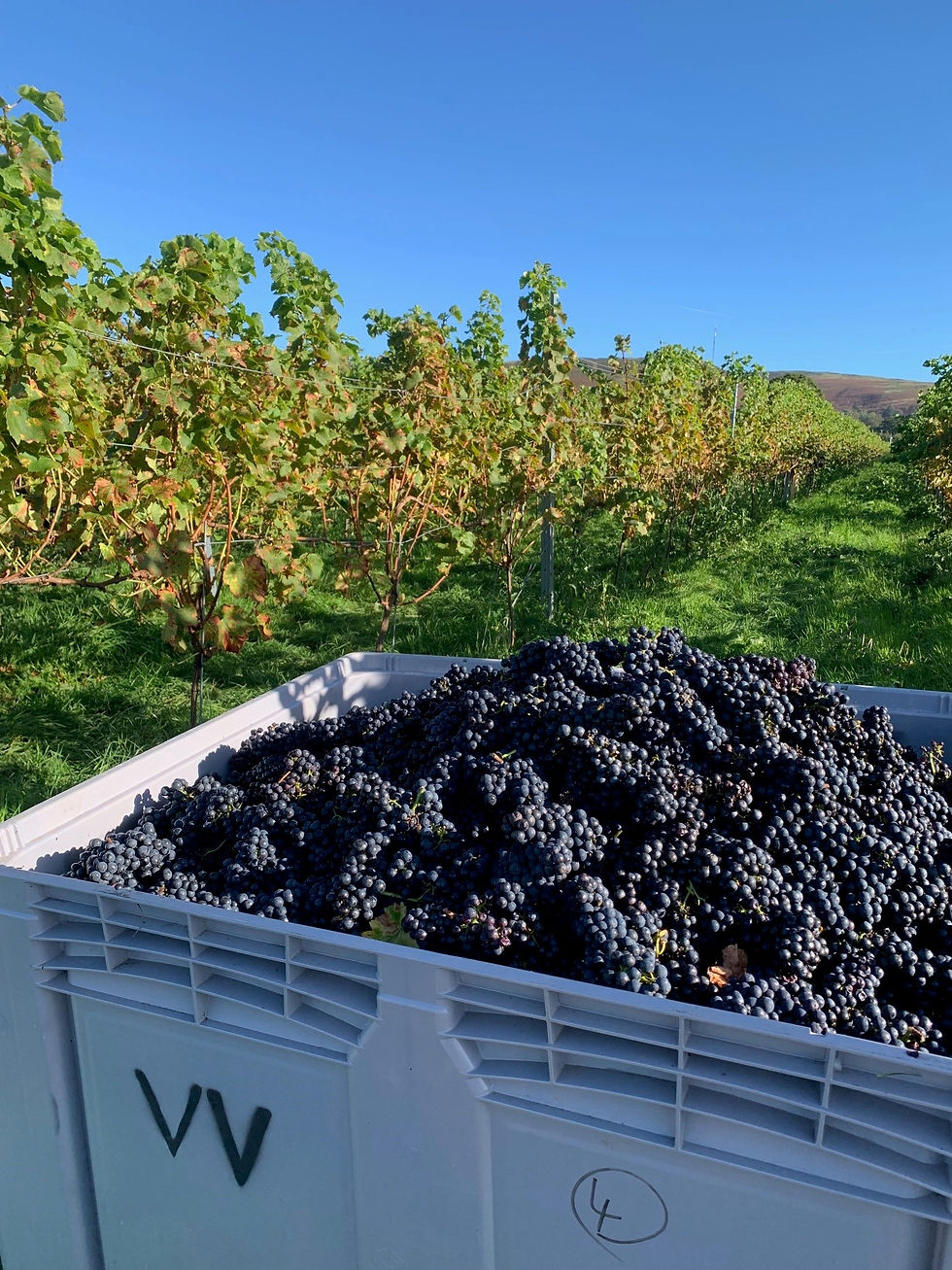
Along with the soaring success of Welsh wines has come an explosion in wine tourism. Many of the vineyards now conduct their own tours and tastings to visitors from this country and beyond – and holidays built around wine trails are also in high demand.
Gwen Davies, who runs the Vale Vineyard with her husband Rhys, in the Vale of Clwyd for the past seven years, has seen increasing popularity for her tours that run between May and September.
“Wine tourism is a growing market – as well as buying the wine itself, there is so much interest in seeing where it comes from. We are now thinking about expanding our tour season but will need
to take on another member of staff to be able to do so.”
Welsh Wine Week, from Friday, May 29 to Sunday, June 7, organised by the Food and Drink Wales Drinks Cluster, part of the Welsh Government’s clustering initiative, in partnership with drinks producers and vineyards, will see a particularly high number of tours, tastings, meet the producer sessions and celebrations take place.
Winning awards
At Llanerch Vineyard Hotel, in the Vale of Glamorgan, the Welsh wine experience has been taken a few steps further. Their Estate wines are crafted exclusively from the grapes grown at the vineyard, while the site is also home to a boutique hotel, restaurant and wedding venue. This is also where Gwin Cymru holds its annual wine awards.
Celebrated, award-winning five-star hotel Plas Dinas Country House also has a small vineyard within its grounds and is currently growing Chardonnay and Phoenix grapes. With a good selection of Welsh wines available, it won the AA the Best Wine List Award for Wales 2024/25. And Jabajak Vineyard, also award-winning, near Whitland, in West Wales, has a restaurant with rooms on its site. Wine tasting experiences are also part of its wider offering.
The common characteristics that are winning national and international acclaim for Welsh wines are quality and cleanliness, says Andy.

Velfrey won Regional Winner for Wales at the Great British Food Awards 2025, and its sparkling wines have won Decanter World Wine Awards medals with one being placed in the top three in its class at the international Glass of Bubbly Awards 2024. Vale saw its Robin Goch red wine crowned Best Alternative Red from the UK last year at the Wine GB awards and Ancre Hill has won multiple awards and accolades for its array of wines over the past 15 years or so.
Gwinllan Llaethliw Vineyard scooped a bouquet of accolades at the Welsh Wine Awards 2025, including Champion Wine of Wales, Best Overall Sparkling Wine, Best PDO/PGI Wine, and Best Sparkling White, and Gwinllan Conwy has been recognised in the Decanter World Wine Awards and International Wine Challenge.

Another great success is the Dell Vineyard in Monmouthshire, run by former graphic designer Dan and his wife Lucy, an intensive care nurse. At the Gwin Cymru Welsh Wine Awards 2025, their Y Lleidr was awarded the Best Rosé and Best Overall Still Wine in Wales.
“This is a really elegant wine,” says Lucy. “It is fruity, with some brioche character and a little quince flavour.”
Among the grapes grown near Raglan by Dell are Solaris, Pinot Noir, Pinot Meunier, Cabaret Noir and Sauvignon Gris. They are soon to taste their new sparkling Blanc de Noir.
“We are very lucky – this is apparently one of the driest areas in the UK and we have very good soil and drainage,” she continues.
“We had a dream that in our 50s we’d come back to Wales and plant a vineyard on the family farm, but then the pandemic hit, and I said to Dan that I couldn’t be a nurse anymore, so we decided to start our retirement plan early. I am still doing some nursing, but I’m hoping to work full-time at the vineyard from next year.”
Andy believes that to build on its growing success, Welsh wine needs to remain at the premium end of the market.
“In order to be able to justify the prices required for our conditions, yield and scale it’s really important that our wine retains its character. It’s not about rushing to grow a big volume of cash crops on mixed farms, it is about the individuals who own the Welsh vineyards, their passion and their attention to detail.”


Comments